
Tracheal Stenosis (Narrowing of the Windpipe)
Assessment, surgery, bronchoscopic procedures and stent options for tracheal narrowing after intubation.
Draft awaiting medical review · General information; not a substitute for an individual assessment.
Content updated: 23 October 2026 · Awaiting physician approval.
What is tracheal stenosis?
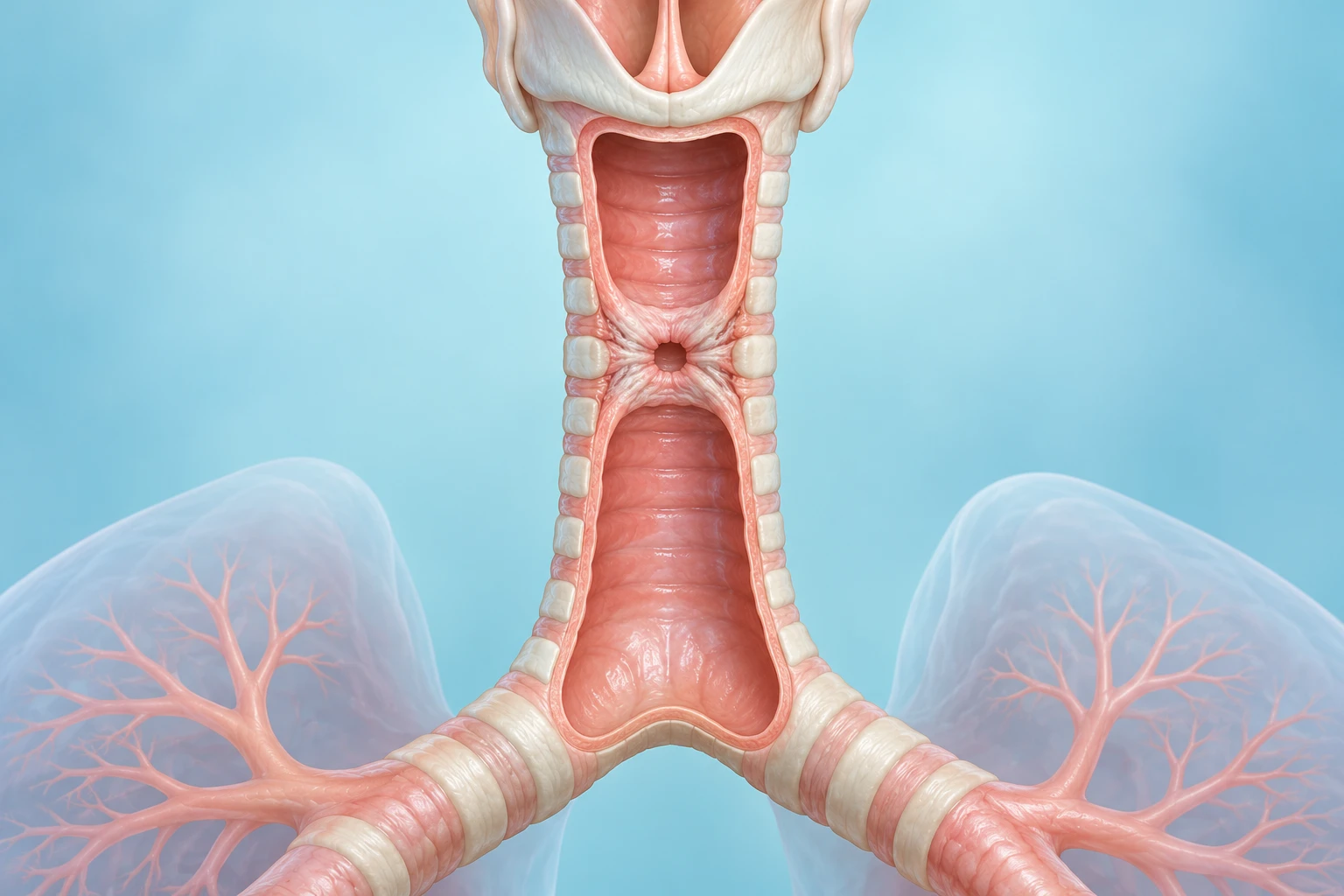
Narrowing of the windpipe makes it harder for air to reach the lungs. This page focuses on benign narrowing after intubation and tracheostomy. Injury where the tube or its cuff contacts the airway may heal with scar tissue that narrows the airway. Not everyone who is intubated develops stenosis. Other causes, such as inflammatory diseases and tumors, require a different assessment.
Symptoms and emergency care
Increasing breathlessness on exertion, cough and noisy breathing may develop weeks or months after tube removal. Symptoms can be mistaken for asthma. Always mention a history of intubation or intensive care. Call 112 in Türkiye for significant breathing difficulty at rest, blue discoloration or breathlessness that prevents speaking.
Diagnosis and treatment planning
CT of the neck and chest and bronchoscopy assess the location, length and severity of narrowing and the cartilage structure. Vocal cords and lung function are examined when needed. In significant narrowing, investigations are planned by a team able to secure the airway. Treatment is individualized through assessment by thoracic surgery, interventional respiratory medicine, anesthesia and ENT specialists when needed.
Bronchoscopic dilation and endoscopic treatment
The narrowed area may be dilated with a balloon or rigid bronchoscopic methods. Controlled incisions into scar tissue or other endoscopic procedures may be added in selected patients. This approach, particularly considered for short, simple stenoses, provides relief for some patients but requires repeated sessions in others. Renarrowing, bleeding and airway injury are possible. Surgical suitability should be reconsidered when procedures are frequently repeated.
Surgery: tracheal resection and anastomosis
Surgery removes the narrowed segment and rejoins the healthy ends of the windpipe. This join is called an anastomosis. In suitable patients, it aims to provide lasting airway patency. It is particularly considered for recurrent or complex narrowing, but is not suitable for everyone. The length of narrowing, relationship to the larynx, previous procedures and general health influence the decision. More extensive airway reconstruction is planned when needed.
Risks discussed include poor healing or separation at the join, recurrent narrowing, infection, bleeding and voice changes. Breathing is closely monitored after surgery; advice on neck movement, nutrition and activity depends on the operation. Success or a fixed recovery time cannot be guaranteed.
When is a stent considered?
A stent supports a narrowed airway from within; it does not remove scar tissue. It may be considered for patients unsuitable for surgery, when other endoscopic treatments do not achieve adequate patency, or in selected cases requiring temporary support. If surgery is possible, a surgical opinion before stenting is important. A stent is not the first option for every stenosis.
Silicone and metal stents
When a stent is needed for benign narrowing, removable silicone stents are often considered. They are usually inserted using rigid bronchoscopy and can be repositioned or removed in appropriate cases. Other supports, such as a Montgomery T-tube, may be considered in selected complex cases.
Metal stents can become embedded in tissue and be difficult to remove. They are not a routine first choice for benign stenosis; after other options have been evaluated, they are considered only in selected situations at specialist centers. A covering does not eliminate all risks.
Follow-up after stenting and surgery
Stents may migrate, become blocked by secretions, become infected or develop granulation tissue at their ends. Follow-up and secretion clearance plans are individualized; bronchoscopy is performed when needed. There is no single time frame for removing or replacing every stent. Contact the treatment team for recurrent breathlessness, noisy breathing, fever or blood in sputum. Before any future anesthesia, disclose your history of stenosis, surgery and stenting.
Frequently asked questions
Is surgery or a stent more suitable?
They are not equivalent alternatives for every patient. The anatomy of the narrowing, previous treatments and fitness for surgery are assessed together.
Does dilation provide a permanent solution?
It may suffice for some selected stenoses; recurrent narrowing may require another procedure or surgery.
Does a stent stay in for life?
Not always. The possibility of removal and the follow-up plan should be discussed before placement.
Is every tracheal narrowing cancer?
No. Scar tissue after intubation is not cancer; investigations establish the cause of narrowing.
Further reading
Sources checked: 23 October 2026. Source checking does not replace physician approval.